

Horse Racing Data Basics
Korean Track Moisture Explained: Dry, Good, Wet, Saturated and Sloppy
Understand Korea Racing Authority moisture bands and learn how to compare performances under different sand-track conditions.
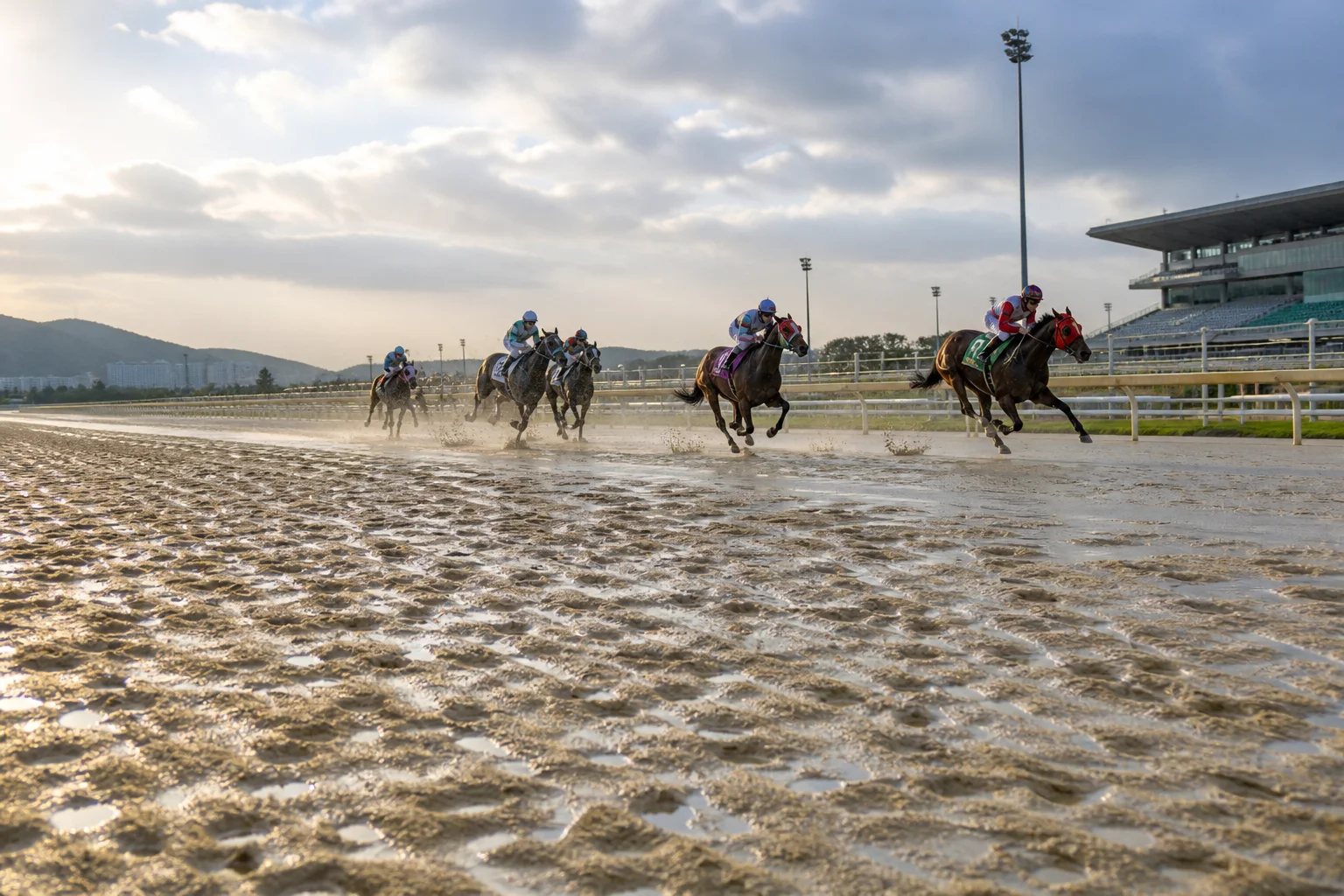
The track-moisture percentage shows how much water is present in Korea’s sand racing surface. KRA groups that figure into five official Korean labels. Checking the latest official reading is more precise than relying only on whether it has rained.
Official KRA moisture bands
| Moisture | Korean label | Practical translation |
|---|---|---|
| 1–5% | 건조 | Dry |
| 6–9% | 양호 | Good |
| 10–14% | 다습 | Wet |
| 15–19% | 포화 | Saturated |
| 20% or more | 불량 | Sloppy / very wet |
The Korean label 불량 is an official description of a very wet surface. It does not mean that race management or a horse is “bad.”
Why moisture matters
Water can change how compact the sand is and how much resistance a hoof meets. It is still too simple to say that a higher percentage always produces faster or slower times. Rain after the reading, watering, harrowing, sand depth and wear from earlier races can all change the surface.
KRA track reports also publish sand depth and maintenance notes. Read them with the percentage rather than treating moisture as a standalone predictor.
How to compare past performances
- Start with races at the same venue.
- Select the same or a nearby distance and class.
- Compare the percentage and official condition.
- Check carried weight and body-weight changes.
- Use video or steward reports to identify trouble in running.
One good finish on a wet track does not prove that a horse is a “wet-track specialist.” Look for repeated performances under genuinely similar conditions.
Check the update time on wet days
When rain continues, the time of the official reading matters. Conditions can change between a morning notice and a later race, or after track maintenance. Recheck the latest report and observe how the surface behaved in earlier races on the card.
No track label automatically favours front-runners or closers. Race pace, field composition and each horse’s running style change from race to race.
Comparing moisture with sectionals
If two races had different moisture readings, comparing their sectionals directly can be misleading. Group performances by venue, distance and similar surface first, then examine S1F and G3F. Read our S1F and G3F guide for those definitions, or start with how to read a Korean race card.
Track moisture is important context, not a result guarantee. Use the latest official condition and compare like with like before adding carried weight, body weight and the actual race shape.
Informational content based on public data. It does not guarantee race outcomes or profit.